.png)




Contingent Workforce Management: The Complete Guide 2026
What is contingent workforce management?
Contingent workforce management is the practice of strategically overseeing the sourcing, engagement, governance, and offboarding of non-permanent workers. This includes contractors, freelancers, temporary staff, statement-of-work providers, and other external workers engaged outside of permanent employment contracts.
Unlike permanent headcount management, contingent workforce management must account for varied engagement types such as shorter tenures, multiple supplier relationships, regulatory obligations, and flexible workforce planning needs. When managed well, it gives businesses the visibility, control, and flexibility they need to build a workforce that responds to business demand without creating long-term cost commitments or compliance risk in the process.
Contingent workforce management for business leaders
Contingent workforce management is one of the fastest-growing priorities for HR and talent acquisition leaders, yet it remains one of the least structured functions within most businesses. Contractors, freelancers, and temporary workers now make up a meaningful share of the workforce across sectors including financial services, technology, and professional services.
With the growth, there is a need for a clear management framework to be in place. Otherwise, this can become a source of operational risk, compliance exposure, and invisible spend. Getting it right is not just a consideration for HR. It is business imperative for C-suite leaders who need their total workforce to perform with consistency and control.

Why contingent workforce management matters for business leaders
For C-suite and HR leaders, contingent workforce management carries strategic weight that extends well beyond HR administration. As businesses increasingly rely on external talent for specialist projects, business transformation programmes, technology initiatives, and demand-driven hiring, the contingent workforce becomes an advantage for the overall business growth.
The challenge is that many businesses have built their contingent workforce practices reactively and incrementally. The result is a decentralised approach where different business units engage their non-perm hires through different channels, with little central oversight, inconsistent onboarding, fragmented supplier usage, and limited data or reporting. In highly regulated sectors such as banking and financial services, this creates a potential compliance and audit risk. In fast-paced industries such as technology and professional services, it creates quality and delivery gaps that directly affect output productivity, project outcomes and business continuity.
Understanding and managing the contingent workforce is therefore not simply a matter of operational convenience. It is a governance priority, a risk management responsibility, and increasingly a competitive advantage for businesses that get it right.
The strategic value of a contingent workforce
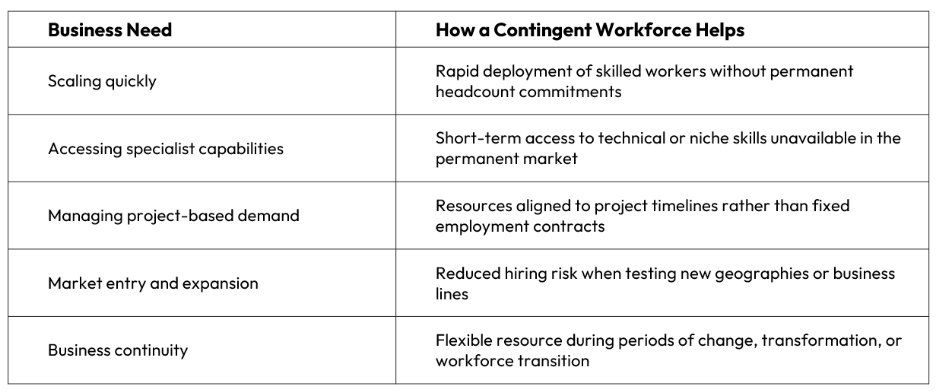
Before addressing how to manage it effectively, it is worth being clear about why the contingent workforce is a strategic asset. Businesses that manage their contingent workers well are not simply filling temporary gaps. They are building a flexible talent infrastructure that supports growth, specialist capability, and operational resilience.
The value is clear. What determines whether businesses capture it consistently is the quality of the management framework around it.
Common challenges in contingent workforce management
Decentralisation is one of the root causes for most common contingent workforce challenges. When hiring managers across business units engage contract hires independently, through different suppliers and without shared processes, the business loses visibility, consistency, and control. These are not minor inefficiencies. They are structural and compliance risks.
Without a centralised view of contractor headcount and spend, businesses cannot accurately assess their total workforce cost or plan effectively for future demand. Without structured compliance processes, they face regulatory exposure that varies significantly by sector and market. In banking and financial services, this includes obligations around contractor classification, data access, right-to-work verification, and audit readiness. In technology, it can mean limited oversight of contractors holding access to sensitive systems or proprietary data.
Fragmented suppliers create its own problems. Businesses engaging multiple agencies without governance often pay inconsistent rates, receive inconsistent quality, and lack any meaningful benchmarking capability. Poor offboarding is another underappreciated risk: when contractors leave without structured exit management, businesses face exposure across system access, confidentiality obligations, and contractual compliance.
These challenges will compound for businesses operating across multiple markets. With each additional country, it introduces a layer of legal and regulatory complexity that a decentralised, locally driven approach is rarely equipped to handle at scale.
What effective contingent workforce management looks like
Effective contingent workforce management is built on three foundations: visibility, governance, and integration.
Visibility means having a real-time view of your entire contingent workforce. For example, who is engaged, on what terms, through which suppliers, at what cost, and with what compliance status. This requires a vendor management system (VMS) that centralises contractor data across business units and markets, giving HR and business leaders the information they need to make informed, timely decisions.
Governance means having structured processes for every stage of the contingent worker lifecycle, from sourcing and onboarding through to contract extensions and offboarding. It includes defined compliance checks, supplier performance management, clear service levels, and escalation paths when issues arise. Good governance is what converts a fragmented contractor relationships into a manageable, auditable, and plannable workforce resource.
Integration means aligning contingent workforce management with your broader talent strategy. Businesses should not see their contingent workforce as a separate and disconnected talent pipeline but as part of a full workforce that contributes coherently to the same strategic objectives. They plan it alongside permanent hiring, workforce modelling, and business demand.
How a Managed Service Provider supports contingent workforce management
For many businesses, the most effective path to structured and centralised contingent workforce management is through a Managed Service Provider (MSP). An MSP takes ownership of the contingent workforce lifecycle on behalf of the client, providing centralised sourcing, supplier management, compliance oversight, VMS integration, and performance reporting through a single managed engagement.
The results this model can deliver are significant. Robert Walters works with a major global banking and financial services company, operating across more than 60 countries, to deliver a fully integrated MSP solution across its Asia operations. Through centralised contractor management, direct sourcing, and SAP Fieldglass VMS integration, the programme manages over 730 contingent workers, with 96% of temporary hires acquired through direct sourcing. The client has achieved 43% in cost savings compared with fragmented agency usage, while maintaining the governance and compliance standards demanded by a tightly regulated banking environment.
What the partnership demonstrates is that MSP is not simply a hiring function. It is a governance, visibility, and workforce management capability that connects contingent hiring to long-term talent strategy, and enables HR and talent leaders to scale their contingent workforce with confidence and control.
What business leaders should do next manage their contingent workforce
For C-suite and HR leaders who are looking to build a more structured approach to contingent workforce management, the first step is to do an honest assessment of the current state. Start by mapping how contingent workers are engaged across your business while identifying where visibility and governance gaps exist. Once the assessment is done, it is easier to define the outcomes you need from a more structured model.
Whether you are at the beginning of that process or ready to explore MSP as a delivery solution, our contingent workforce specialists work with businesses across regulated industries and global markets to design structures that fit their scale, complexity, and compliance requirements.
Speak with our experts to understand what a managed approach could achieve for your businesss.
Meet our expert MSP team

Jenny Fulton
Managing Director APAC - Outsourcing, Robert Walters
Jenny leads Robert Walters' most strategic client partnerships across APAC, bringing deep regional expertise to help organisations navigate talent opportunities across mature and emerging markets.

Charlie O'Farrell
Head of Growth, APAC
Charlie drives growth initiatives across APAC, leveraging over 15 years of experience in operations and growth to deliver strategic, tailored workforce solutions that help clients thrive.
FAQs
-
What types of workers are included in contingent workforce management?
Contingent workforce management covers all forms of non-permanent external labour. This typically includes contractors on fixed-term engagements, temporary workers sourced through staffing suppliers, freelancers hired for specific deliverables, and statement-of-work providers engaged for defined project outcomes. In some businesses, it also extends to interns, secondees, and independent consultants. The exact scope depends on the business's workforce mix and the regulatory environment it operates in, but the management principles of visibility, governance, and compliance apply consistently across all categories. -
What is a Vendor Management System and why does it matter?
A Vendor Management System (VMS) is a technology platform that centralises the management of contingent workers and the suppliers who provide them. It tracks contractor records, contract status, compliance documentation, spend data, and performance analytics in a single environment. For businesses with significant contingent workforces, a VMS is the infrastructure that makes visibility and governance operationally possible. Without it, businesses typically manage fragmented data across spreadsheets and individual supplier relationships, which makes accurate workforce planning and compliance management extremely difficult. -
How does an MSP differ from using individual recruitment agencies for contingent hiring?
A Managed Service Provider manages the entire contingent workforce programme on behalf of the business, including sourcing strategy, supplier oversight, compliance management, and performance reporting. Individual agencies provide access to candidate pools but operate without accountability for programme governance, spend management, or cross-supplier consistency. An MSP integrates multiple suppliers into a single governed structure, reducing the operational burden on internal teams, improving visibility over spend and quality, and creating a more consistent and auditable process for all contingent hiring activity. -
What are the compliance risks of an unmanaged contingent workforce programme?
Unmanaged contingent workforce programmes carry several compliance risks. These include incorrect worker classification, which can create tax and employment law liabilities; gaps in right-to-work verification; inadequate data security controls for contractors with system access; and insufficient audit trails in regulated industries. In sectors such as banking and financial services, regulatory obligations around third-party workforce management are particularly demanding. Poor offboarding is also a consistent risk, leaving business exposed to issues around system access, confidentiality, and contractual obligations after a contractor's engagement ends. -
How do we know if your business needs an MSP for contingent workforce management?
Common indicators that an MSP could add significant value include: a large or growing contingent worker population, multiple business units engaging contractors independently without shared oversight, limited visibility over total contractor spend and headcount, compliance challenges in regulated markets, and heavy reliance on fragmented agency relationships. If your internal talent acquisition team is spending significant time managing contractor administration rather than strategic hiring, that is also a strong signal that a more structured and managed approach would improve both governance and delivery quality.
Related content
View All
Embarking on a global expansion strategy is an exciting, yet complex undertaking. While attention often turns to market entry, legal frameworks, and operational logistics, the single most critical factor for success, especially in an offshoring model, is accurately defining and acquiring the right t
Read More
Welcome to the world of nurture. Marketers have been using it for years to communicate with interested leads, influence the buyer’s journey and convert them into customers. Why should the candidate experience be any different? Robert Walters' Candidate Experience in the Expectation Economy research
Read More