.png)




What Is A Shared Service Centre? A Guide For Leaders
What is a shared service centre?
A shared service centre (SSC) is a centralised business unit that delivers common operational functions, such as finance, HR, IT, compliance, and customer operations, across multiple parts of an organisation. Rather than duplicating these activities in every market or business line, leaders consolidate them into a single hub designed for efficiency, consistency, and scale.
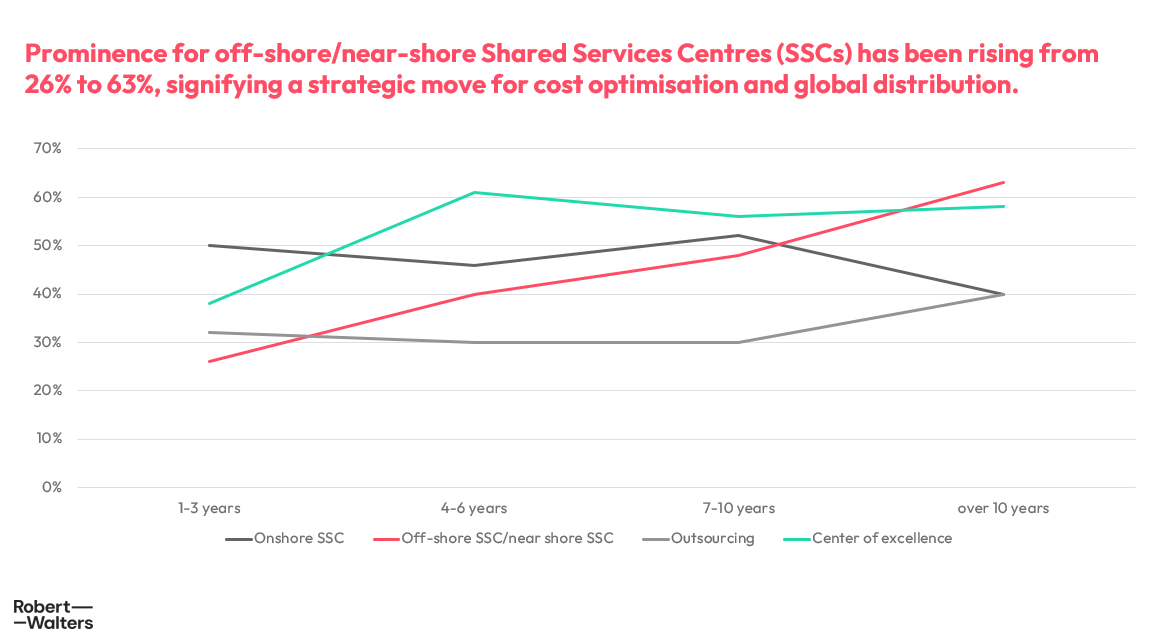
For financial services leaders, SSCs have shifted from a back-office cost play to a strategic capability. Our recent Market Intelligence data shows the prominence of off-shore and near-shore SSCs has risen from 26% to 63% over the past decade, signalling a clear move toward cost optimisation, global distribution, and access to specialist talent.
The challenge for most organisations is not whether to consider an SSC, but how to design, locate, and scale one without underestimating the talent and operational complexities involved.
Why shared service centres matter for financial services leaders
Financial services organisations operate under intense pressure: tighter regulation, rising cost-to-income ratios, accelerating digital transformation, and growing demand for specialist skills in compliance, risk, technology and data.
Shared service centres help leaders respond to these pressures by:
- Consolidating fragmented operations into a single governance model
- Reducing duplication across regions and business units
- Accessing deeper talent pools in lower-cost, high-capability markets
- Standardising processes to support regulatory and audit requirements
For HR, TA and C-suite leaders, the SSC conversation is no longer purely about cost. It is about building a workforce model that is resilient, scalable, and able to support long-term growth.
Key functions and examples of shared services
At its core, an SSC operates as an internal service provider. Business units across the organisation become its "customers", with clearly defined service-level agreements, governance, and performance metrics.
A mature SSC typically delivers across three layers:
1. Transactional services
High-volume, repeatable activities such as accounts payable, payroll processing, claims handling, KYC checks, and first-line customer support. These are the traditional foundation of most SSCs and usually deliver the fastest cost savings.
2. Specialist and knowledge-based services
More complex work including financial analysis, regulatory reporting, risk modelling, technology development, data analytics, and HR business partnering. This layer has driven much of the recent growth in financial services SSCs, particularly in India and the Philippines.
3. Centres of excellence
The most strategic layer, where SSCs evolve into centres of excellence that own innovation, automation, and process design. Industry data shows centres of excellence consistently command the highest share of mature SSC activity, reflecting their role in long-term value creation.
Why leaders are choosing India and the Philippines
Among offshore SSC destinations, India and the Philippines remain the most established for financial services organisations.
Shared service centre India offers:
- A deep talent pool in finance, technology, analytics, and risk
- Strong English-language proficiency and global delivery experience
- Mature SSC ecosystems in Bengaluru, Hyderabad, Pune, Mumbai, and Gurugram
- Significant capability in advanced services such as data science, cybersecurity, and AI
Shared service centre Philippines offers:
- Strong capability in customer operations, voice services, and shared finance
- High cultural affinity with UK and US markets
- Established hubs in Manila, Cebu, and Clark
- A growing footprint in mid- and back-office financial services functions
The choice between markets often comes down to the type of work being moved, the specialist talent required, and how the SSC fits into the broader global capability strategy.
Common pitfalls when setting up or expanding an SSC
Expansions are already happening across financial services, but many leaders move forward without a clear blueprint. The most common pitfalls include:
Underestimating talent competition: In mature SSC markets, attracting and retaining specialist talent is as challenging as in onshore locations.
Underestimating the scale and hiring speed: SSC launches and expansions often require hundreds of hires within tight timeframes. Internal TA teams rarely have the capacity to deliver at this scale alongside business-as-usual hiring, which is where RPO solutions can support flexible high-volume hiring needs.
Treating the SSC as a cost project rather than a capability strategy: Short-term savings alone rarely deliver long-term value.
Weak workforce planning: Hiring volumes, role profiles, and skill mixes are often based on internal assumptions rather than local market intelligence.
Inconsistent governance: Without clear accountability between onshore and offshore teams, processes drift and quality suffers.
Limited employer brand presence: Many financial services organisations are well known onshore but compete against established local employers in offshore markets.
Addressing these pitfalls early is what separates SSCs that deliver lasting value from those that stall after the first wave of cost savings.
What leaders should do next
For HR, TA and C-suite leaders considering an SSC, or looking to expand an existing one, a small number of decisions shape long-term success.
1. Start with the operating model, not the location: Define which functions belong in the SSC, what level of complexity you want it to absorb over time, and how it integrates with onshore teams.
2. Ground location decisions in talent data: Cost is important, but availability of specialist talent, salary inflation, attrition trends, and competitor activity matter more over a five- to ten-year horizon.
3. Plan for the full talent lifecycle: Attraction, hiring, onboarding, retention, and capability development all need to be designed deliberately, not assumed.
4. Build governance from day one: Clear ownership between the SSC, regional hubs, and headquarters reduces friction and supports regulatory expectations.
5. Plan for hiring scale, not just headcount: SSC build-outs and expansions typically involve concentrated hiring spikes, sometimes hundreds of roles within 6 to 12 months. Project RPO offers a flexible, short-term model to scale hiring capacity quickly without permanent investment in internal TA infrastructure, before winding down as the SSC stabilises.
6. Treat the SSC as a long-term capability: The organisations seeing the strongest returns are those evolving their SSCs into centres of excellence rather than fixed cost centres.
Building a shared service centre that delivers
A well-designed shared service centre can give financial services organisations meaningful advantages: cost discipline, access to specialist talent, operational resilience, and a platform for future growth. A poorly designed one can absorb investment without delivering the capability uplift leaders expected.
The difference usually comes down to how deliberately the SSC is planned, located, staffed, and governed.
If you are exploring whether an SSC fits your workforce strategy, or looking to expand an existing offshore footprint in India, the Philippines, or other markets, our offshoring talent specialists can help you make a more informed decision.
Download our Offshoring Talent Solutions E-Guide for a practical view of how leading organisations are building and scaling shared service centres, or explore our offshoring talent solutions to discuss your specific plans.
-
What is the difference between a shared service centre and a global capability centre?
A shared service centre typically focuses on consolidating transactional and operational functions to drive efficiency and standardisation. A global capability centre (GCC) goes further, owning specialist, strategic, and innovation-led work such as analytics, technology development, and product design. Many SSCs evolve into GCCs over time, particularly in financial services, where demand for specialist talent in risk, data, and digital is accelerating. The distinction is less about location and more about the complexity, value, and strategic role the centre plays within the wider organisation. -
Why are financial services organisations expanding shared service centres offshore?
Financial services organisations are expanding offshore SSCs to manage cost-to-income pressure, access deeper specialist talent pools, and build operational resilience across regions. Offshore and near-shore SSC adoption has risen significantly over the past decade, reflecting a strategic move toward global distribution rather than pure cost reduction. India and the Philippines remain the most established markets, offering strong capability in finance, technology, risk, analytics, and customer operations. For many leaders in financial services, offshore SSCs now play a central role in workforce planning and long-term capability building, not just back-office support. -
Is India or the Philippines better for a shared service centre?
Neither market is universally better. The right choice depends on the type of work, the talent profile required, and how the SSC fits into your global operating model. India is typically stronger for technology, analytics, risk, and complex finance roles, supported by deep specialist talent pools. The Philippines is typically stronger for customer operations, voice services, and shared finance functions, with strong cultural alignment to UK and US markets. Many financial services organisations operate in both markets, using each location for the work it is best suited to deliver. -
How long does it take to set up a shared service centre?
Setting up a shared service centre usually takes 9 to 18 months, depending on scope, location, regulatory requirements, and the complexity of work being transferred. Early phases focus on operating model design, location assessment, and workforce planning. Mid-phase activity covers entity setup, real estate, technology, and initial hiring. Later phases focus on process migration, governance, and stabilisation. Financial services organisations with strict regulatory obligations often require longer timelines. Partnering with offshoring and talent specialists during planning can significantly reduce risk and accelerate time to operational readiness. -
What roles are typically hired into a shared service centre?
Roles vary by maturity. Early-stage SSCs focus on transactional roles in finance, HR, operations, and customer service. As the SSC matures, hiring shifts toward specialist roles in risk, compliance, technology, data analytics, cybersecurity, and product development. Leadership roles, including SSC heads, function leads, and centre of excellence leaders, become critical as the centre evolves. In financial services, demand is particularly high for regulatory reporting, financial crime, model risk, and digital transformation specialists. Workforce planning should account for this evolving role mix rather than focusing only on initial hiring volumes. -
How do shared service centres support business growth?
Shared service centres support growth by freeing onshore teams to focus on client-facing, strategic, and revenue-generating work whilst consolidating operational delivery in scalable hubs. They provide access to specialist talent, support faster market expansion, and create a more resilient workforce model. Mature SSCs evolve into centres of excellence that drive automation, innovation, and process improvement across the organisation. For leaders in financial services who are managing cost pressure, regulatory demands, and digital transformation simultaneously, SSCs offer a way to build long-term capability without proportionally increasing onshore headcount or operational risk.
Related content
View All
A guide to global capability centres (GCCs) For banking, insurance, and financial services firms, growth is increasingly shaped by access to talent. As hiring pressure rises across operations, technology, compliance, analytics, and customer support, many organisations are rethinking how and where th
Read More
Talent acquisition is generally understood as the longer-term process of identifying the capabilities an organisation may need, understanding where those skills can be found and building an approach to reaching and hiring them. Recruitment typically forms one part of that process and often begins on
Read More
The most effective talent strategies are shaped around the organisations they’re designed for. For a global organisation like MUFG, with 150,000 employees across 40 countries, that means balancing global ambition with the needs of its people, teams and local markets. In a recent HR Chief feature, Be
Read More